MEP Engineering Toolbox
Browser-based engineering calculation toolbox by Eng. Joe Saad. Formerly the Pipe Slope & MEP Calculator.
01Overview
What the toolbox is for
The MEP Engineering Toolbox is a calculation toolbox that runs in any modern browser. It started as the Pipe Slope & MEP Calculator, a tool for drainage slopes and levels, and has grown into 20 modules across hydraulics, HVAC, thermal engineering and utilities.
Every module shows its formulas, assumptions, references and limitations, and the calculation core is checked by regression tests against an independent reference implementation.
- Projects and calculation history, with export and import
- Printable calculation reports with step-by-step working (detailed or summary)
- Light and dark themes
- Runs in any modern browser, with no installation
02Screenshots
The application
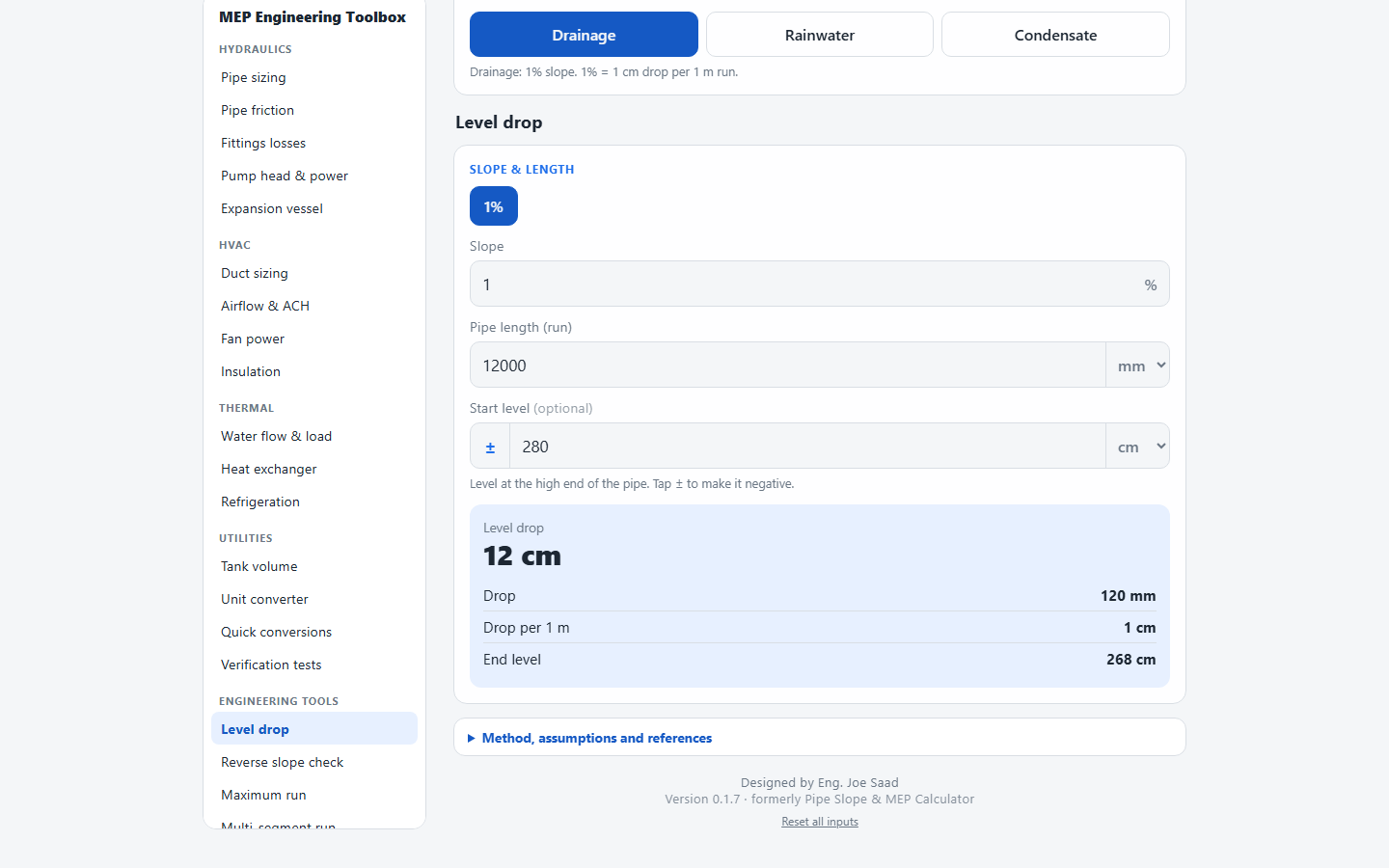
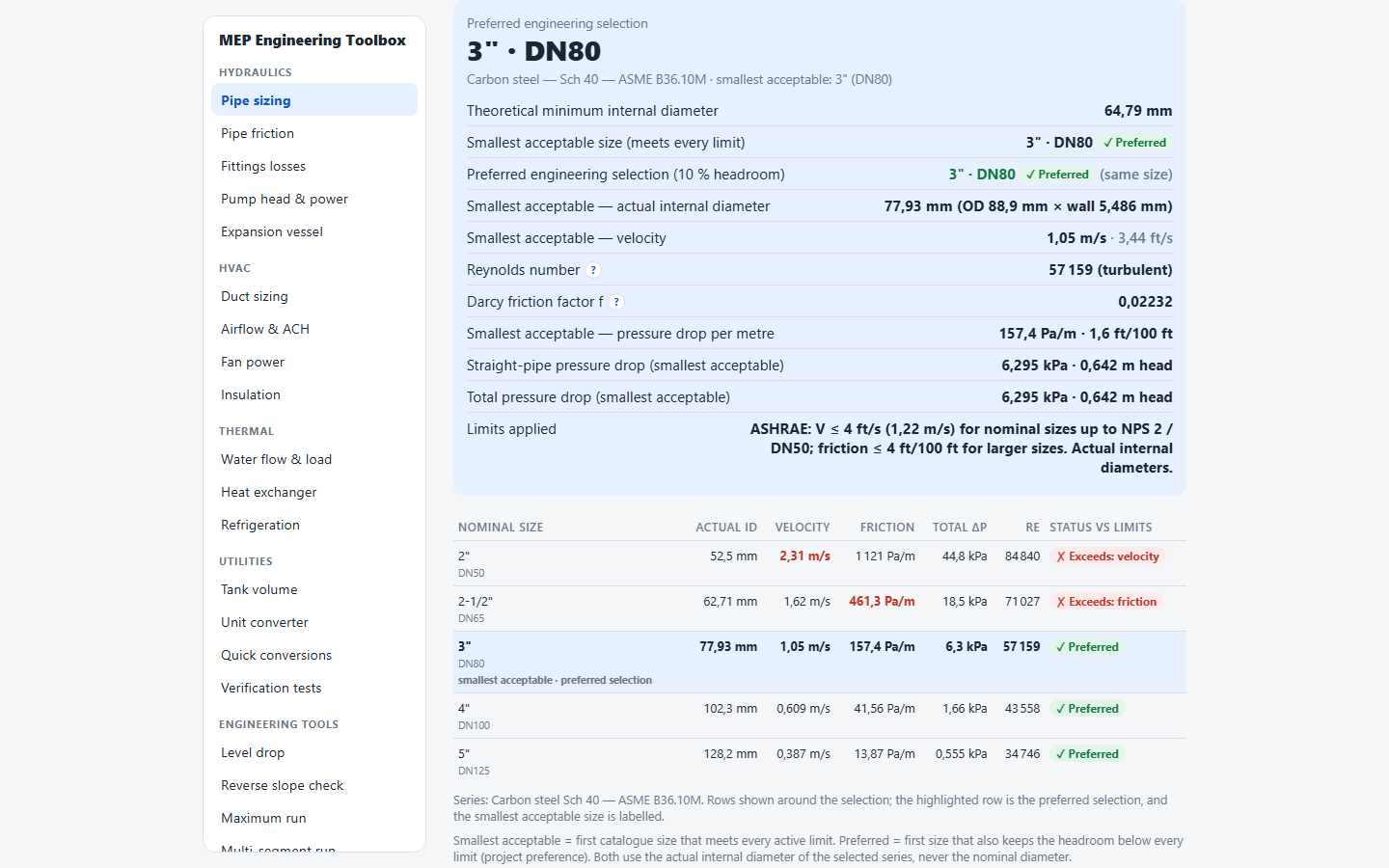
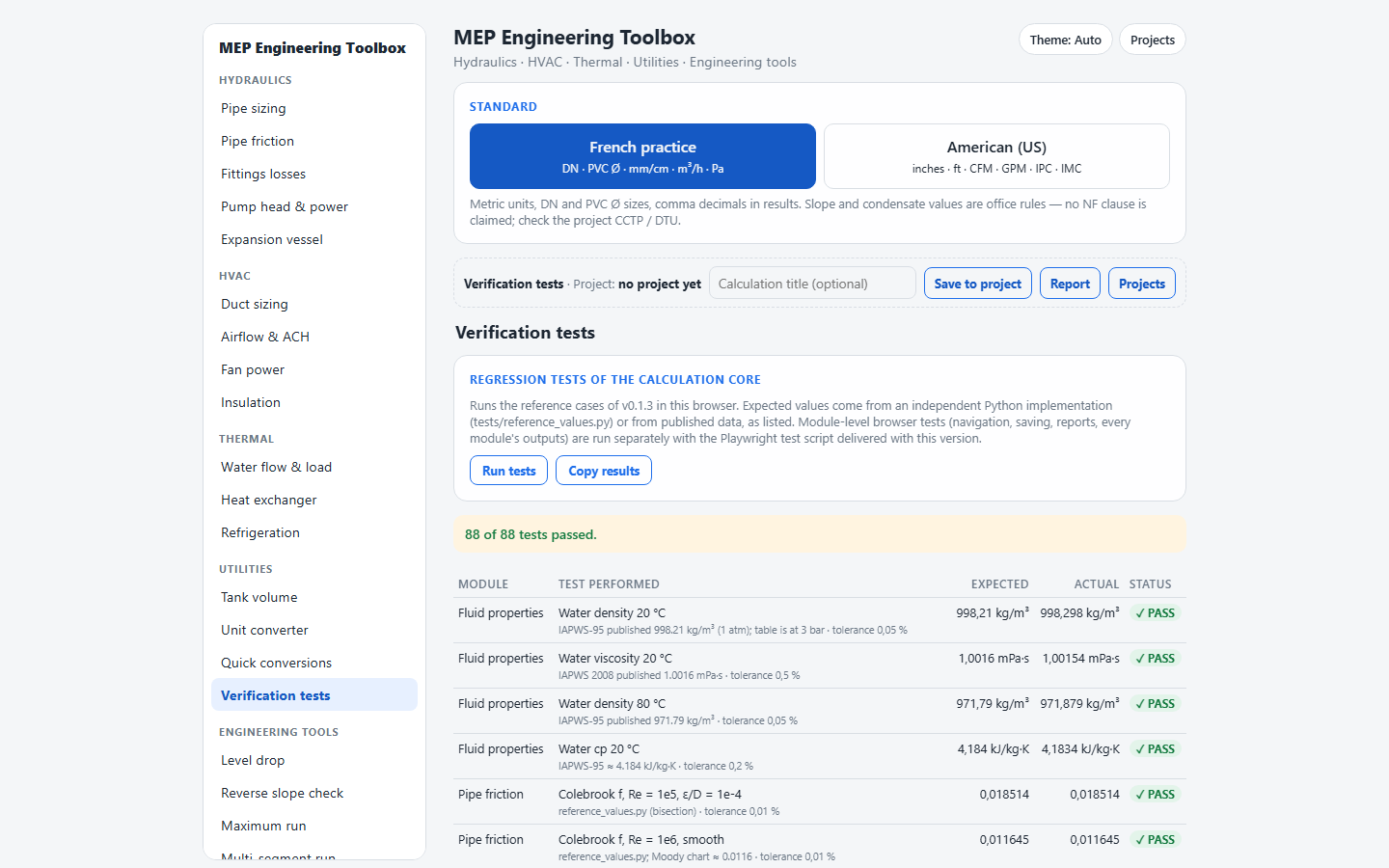
Screenshots of version 0.1.7, taken from the actual application.
03Features
Feature categories
20 modules, each with its formulas, assumptions, references and limitations shown next to the result.
Hydraulics
- Pipe sizing
- Pipe friction
- Fittings losses
- Pump head & power
- Expansion vessel
HVAC
- Duct sizing
- Airflow & ACH
- Fan power
- Insulation
Thermal
- Water flow & load
- Heat exchanger
- Refrigeration
Utilities
- Tank volume
- Unit converter
- Quick conversions
- Verification tests
Drainage & slopes
Drainage, rainwater and condensate systems
- Level drop
- Reverse slope check
- Maximum run
- Multi-segment run
04Live demo
Try it here
The full application runs below. It makes no network requests: what you enter stays in your browser.
Interactive
Load the toolbox inside this page. It is about 400 kB and runs entirely in your browser.
05Methodology
Technical methodology
The main calculation methods, as documented inside the application.
Pipe hydraulics
Darcy–Weisbach with the Colebrook–White friction factor (64/Re in laminar flow), water properties from IAPWS data and tabulated glycol properties. ASHRAE velocity and friction guidance is applied as design guidance, not as a code requirement.
Fittings
K-method and equivalent length from Crane TP-410, with Kv/Cv valve coefficients (IEC 60534 definitions).
Pumps
Duty point for closed loops and open systems: friction, fittings and equipment losses with a user allowance, then hydraulic, shaft and electrical power and the next standard motor rating.
Expansion vessels
EN 12828 vessel-sizing method as published by manufacturers, with an ASHRAE diaphragm-tank cross-check. Glycol expansion uses glycol densities.
Ducts
Darcy–Weisbach with Colebrook–White, Huebscher equivalent diameter for rectangular ducts, EN 1506 round sizes, and an Altshul–Tsal cross-check.
Insulation
Steady one-dimensional conduction with Churchill–Chu natural convection and a dew-point check on the outer surface.
Drainage slopes
Level-drop geometry with exact inch-per-foot minimums from IPC Table 704.1 and IMC 307.2 in American practice.
06Standards & assumptions
Engineering practice and assumptions
French practice
DN, PVC Ø, mm/cm, m³/h, Pa. Office presets, no code minimum claimed.
American practice
Inches, ft, CFM, GPM, with IPC and IMC minimum-slope checks.
- Results are preliminary design aids. They are not code-compliance checks and do not replace manufacturer selections.
- Each module lists its own assumptions and limitations next to the result.
- Design limits shown in colour are project preferences unless a code clause is named.
07Verification
How results are checked
The calculation core is written as pure functions and checked by built-in regression tests. Expected values come from an independent Python reference implementation or from published property data.
Version 0.1.7: 88 of 88 built-in regression tests passed when run in Microsoft Edge on 24 November 2026.
Every result item carries one of five verification classes:
- ICIndependently checked
- CACalculated — no independent test
- UIUser-entered input
- MVManufacturer verification required
- NVNot verified
08Version history
Version history
From the Pipe Slope & MEP Calculator to the current toolbox.
- v0.1.7
Calculations record their own structured steps for reports; reports open from an immutable snapshot; variable definitions for every module; traceability review with five verification classes.
- v0.1.6
Report mode with detailed or summary calculation steps; layout fixes for reports on phones.
- v0.1.5
Versioned, validated and bounded loading of saved data with backups; explicit design-flow mode for pumps; monotone pump-curve interpolation; verification status per item.
- v0.1.4
Saved data sanitised before use; expansion-vessel handling of water's density maximum near 4 °C.
- v0.1.3
Calculation core moved to pure functions with regression tests; Colebrook–White duct friction; ISO 4065 plastic pipe walls; exact unit round trips.
- v0.1.2
Typed slopes kept across reloads and standard changes; projects for saved calculations.
- v0.1.1
US sanitary slope checks use exact inch-per-foot thresholds.
- v0.1.0
MEP Engineering Toolbox: new hydraulics, HVAC, thermal and utility modules added to the slope tools of the Pipe Slope & MEP Calculator.
Use the toolbox
Open it in your browser and try it with your own numbers.